On 19 September 2025, the White House imposed a $100,000 payment on certain new H-1B petitions, the work visa for skilled foreign professionals in the United States. A year later, a Massachusetts court struck the measure down on 8 June 2026. It was temporarily reinstated four days later, blocked again since 24 July, then extended by a new proclamation to 21 September 2027. On 30 September, a second federal judge blocked it as well. Meanwhile, the Department of Homeland Security proposed in August a permanent fee of roughly $103,000 on cap-subject H-1B petitions.
If you run a company that hires in the United States, or plans to send talent there, remember one thing: the fee is not the main problem. The problem is that nobody can tell you what it will be six months from now.
What US employers actually did
Envoy Global's annual report on US corporate immigration, published in June 2026 and based on a survey of 519 employers, paints a clear picture of the response:
- 60.9% of employers relocated staff outside the United States because of visa denials or delays, up from 48.6% a year earlier.
- Nearly 68% plan to increase nearshoring or offshoring in 2026 to work around immigration barriers and labour shortages.
- Financial services, consulting and tech are the sectors shifting most strongly towards what the report calls global redistribution of teams.
These companies are not hiring less foreign talent. They have stopped bringing talent to the United States and are moving the work to the talent instead.
Why the uncertainty costs more than the fee
A company can budget a $100,000 fee. It can decide that a rare profile is worth it, or that it is not. That is a calculation.
What it cannot budget is a rule that changes four times in four months. An H-1B hire is planned over a year: the spring lottery, filing, processing, arrival. Throughout that time, the rule can be struck down, reinstated, extended or replaced.
In practice, this instability creates three costs that never show up in a spreadsheet.
The project that waits
A client signs in March. The delivery team depends on two people arriving on visas. If one is blocked, the project slips. The cost is not the fee: it is the lost quarter and the client's trust.
The candidate who goes elsewhere
An engineer who waits months for an answer ends up accepting another offer. Envoy Global's report shows it: 65% of employers say foreign employees left the United States for visa-related reasons over the past year.
The decision nobody makes
The heaviest cost is often the quietest. Faced with uncertainty, the leader postpones. The role stays closed, the project stays on hold, everyone waits for the next court ruling. Meanwhile, competitors who already have a fallback model keep moving.
What it means for a French company in the US
For a French company setting up across the Atlantic, the natural reflex is to send its best people there. That makes sense for a handful of key roles: local leadership, sales, client relationships. But building your entire delivery team on visas means building on ground that lawmakers and courts redraw every quarter.
The question is no longer "how do I get my people into the United States?". It is "which roles genuinely need to be in the United States?".
In most cases, the answer is short:
- On the ground: what touches the client, the market and decisions. Leadership, sales, account management, sometimes a small pre-sales team.
- Remote: what produces. Engineering, data, support, finance, back-office functions.
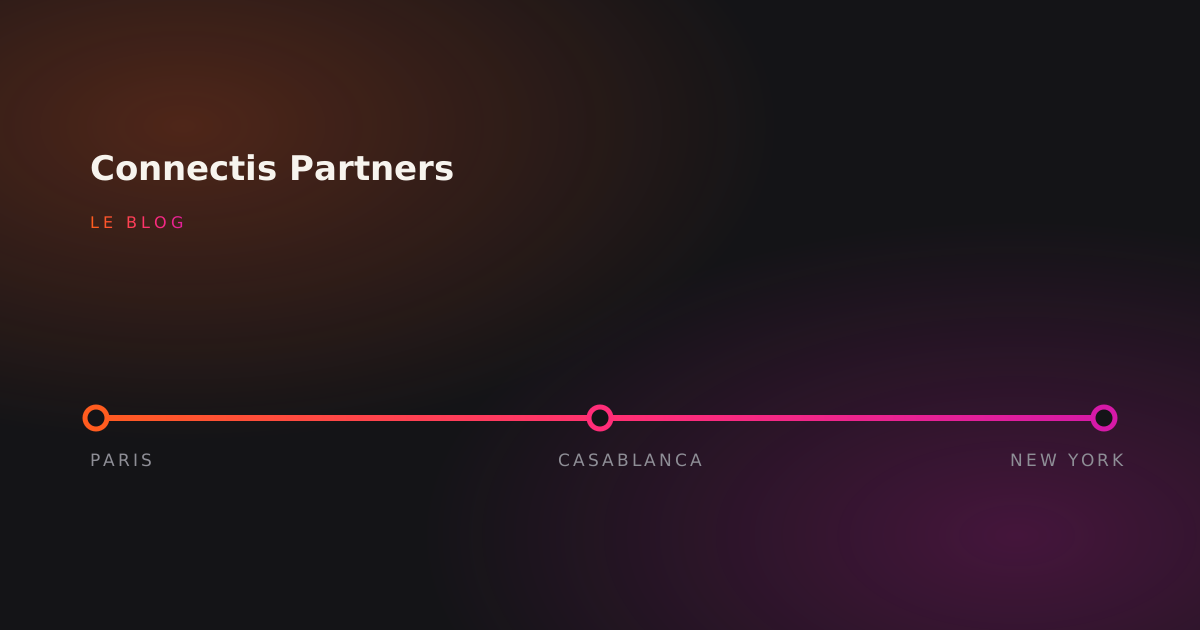
That is the corridor logic: a light, visible presence in the United States, backed by a stable delivery team in a country where you control the rules.
Why Morocco belongs in the equation
US employers instinctively name Latin America, India or Eastern Europe. For a French company serving American clients, Morocco offers a combination that few of those destinations offer all at once.
Time zone
Since Morocco returned to GMT on 20 September 2026, a 9am to 6pm day in Casablanca covers New York's morning from 9am to 1pm in winter. The same team works with Paris at a one- or two-hour gap. One team, two markets, real overlap hours with both.
Language
A Moroccan team works fluently in French, and increasingly in English in tech and service roles. For a French company, that means headquarters and the US subsidiary served by the same people, with no translation layer.
A stable framework
The status of a team in Morocco does not hinge on an annual lottery or a US court ruling. Local employment law, taxation and offshoring incentives are known and can be planned for. You can get hiring or management wrong. You will not wake up on a Monday to find the rule has been struck down.
What we would do in your position
If you have US hires underway or planned for 2027:
- List every role that depends on a visa. For each one, ask: does this role need to be physically in the United States?
- Price the fallback scenario. What does the same role cost in a nearshore team, and how long does it take to build? Do not reason on day rates alone: include management, tooling and ramp-up.
- Separate the visible from the productive. Keep on US soil what drives the client relationship. Place delivery elsewhere.
- Do not bet on the next ruling. The appeal is ongoing and the permanent fee is being prepared. Build a model that works whatever the outcome.
- Start small. A team of three to five people is enough to test the model before moving an entire scope.
The bottom line
The H-1B fee is a signal, not an anomaly. It says that access to talent on US soil will stay expensive and uncertain for years, whatever happens in court. The companies that come out ahead are not the ones waiting for the ruling. They are the ones that already have a model where the question no longer matters.
Connectis Partners supports French companies along the Paris, Casablanca, New York corridor: commercial presence in the United States, delivery team in Morocco. If this question is on your desk, write to us.
Sources: presidential proclamations of 19 September 2025 and 18 September 2026; Fragomen and Ellis (status as of 21 September 2026); Reuters (30 September 2026); Envoy Global, U.S. Corporate Immigration Trends 2026.