On the night of 19 to 20 September 2026, Morocco turned its clocks back one hour. The country has dropped GMT+1, in place almost permanently since 2018, and returned to GMT as its legal time. The head of government announced the decision on 25 June. This time it is not a Ramadan interlude: there is no planned return to GMT+1 next summer.
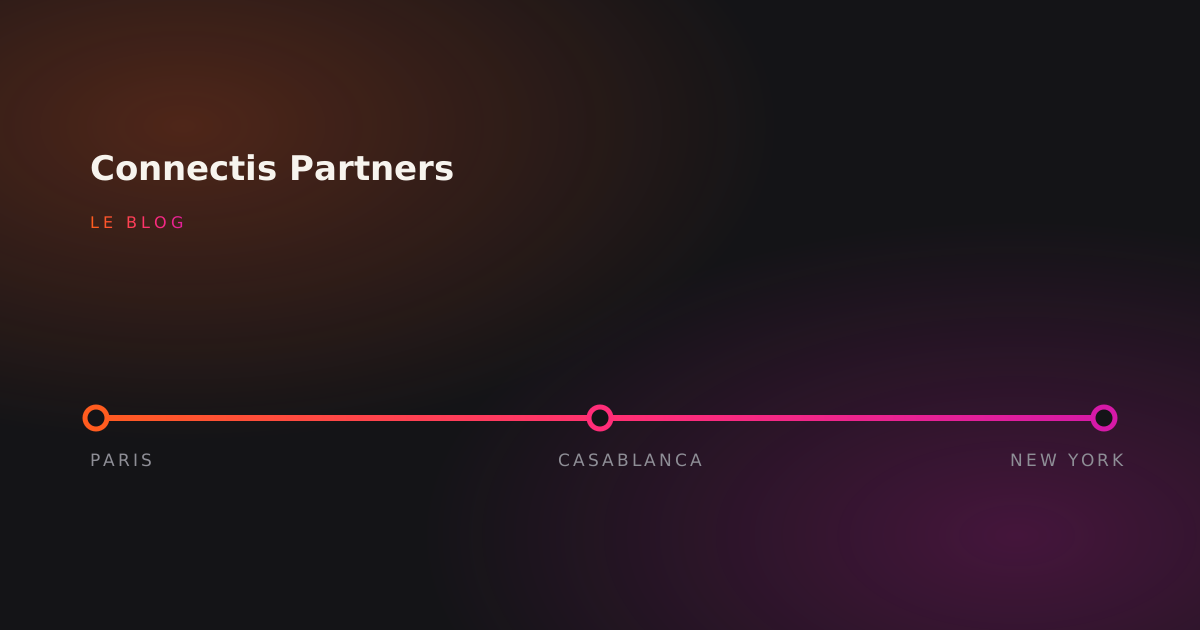
For individuals, that is an extra hour of sleep. For a company running a team across Paris, Casablanca and New York, it is a new shape for the working day. It deserves an hour of your attention. No more, but that hour.
What actually changes
For eight years, Casablanca lived almost on Paris time: the same hour in winter, one hour behind in summer. You could run a Moroccan team like a team in Lyon without ever looking at a clock.
Now Morocco no longer changes its clocks, but France and the United States still do. The result:
- With Paris: one hour apart in winter, two in summer. Until 25 October, it is 9 a.m. in Casablanca when it is 11 a.m. in Paris.
- With New York: five hours apart in winter, four in summer. Morocco moves one hour closer to the US East Coast.
- Twice a year, Europe and the United States change their clocks on different weekends. For those few days, every gap shifts at once.
Nothing dramatic. But everything that was implicit in your organisation is suddenly wrong.
What breaks first
Recurring meetings
A daily stand-up set at 9:30 a.m. Paris time now lands at 7:30 a.m. in Casablanca in summer. Nobody will say so in the meeting. The team will show up, cameras off, and the quality of the discussion will drop without you understanding why.
The rule is simple: every recurring ritual needs an owner who has checked the time on both sides. Not the calendar. A person.
Service commitments
A contract promising coverage "from 8 a.m. to 6 p.m." without naming a time zone is now ambiguous. Paris time or local time? Reread your service levels, on-call rotas and escalation procedures. State the time zone every time. It is one line, and it prevents a dispute.
Automations
Scheduled jobs, planned releases, reports sent at a fixed time, customer reminders: anything running on a hard-coded "Morocco" time needs checking. Properly configured systems follow the official `Africa/Casablanca` time zone and adjusted on their own. The others have been an hour early for a week.
Team hours
A team that starts at 9 a.m. local time now starts at 10 or 11 a.m. Paris time. If your business needs people online at 9 a.m. French time, decide it explicitly, agree it with the team and put it in the employment contracts. Do not assume it.
What it opens up
The instinct is to see a time gap as a constraint. Often it is the opposite.
The US corridor becomes more natural
In winter, a 9-to-6 day in Casablanca now covers the New York morning from 9 a.m. to 1 p.m. Four hours of genuine overlap, against three before. For a company serving US clients from Morocco, that is one more hour when the team and the client are awake at the same time.
The three-way window is clearer too. In winter, between 3 and 6 p.m. in Paris, which is 2 to 5 p.m. in Casablanca and 9 a.m. to noon in New York, all three sites are working together. That is where decisions involving everyone belong.
The gap becomes a relay
Paris being one or two hours ahead means a morning where the French team frames the work, and an end of day where the Moroccan team delivers while Paris closes. Well organised, the gap extends the useful working day instead of shrinking it. The condition: the handover is written, not spoken.
The real lesson: asynchronous management
This clock change is a test. If a one-hour shift throws your team off balance, the problem is not the hour. It is that everything depends on people being online at the same time.
Distributed teams that work share a few habits:
- Decisions are written down. What was settled in a meeting lives in a document, not in the memory of whoever attended.
- Synchronous time is kept for what deserves it. Trade-offs, disagreements, people issues. Everything else goes in writing.
- The end of the day is a handover. Each site leaves the other a clear status: what is done, what is blocked, what is waiting for an answer.
- Overlap hours are protected. No solo work goes there. It is time for exchange, not for producing in silence.
That is also where respect for the team shows. A team summoned at 7:30 a.m. because nobody checked the calendar understands exactly where it sits in your priorities.
Your checklist for this week
If you have a team in Morocco, here is what we would do in your place:
- Reset recurring meetings, checking each participant's local time.
- Reread your service commitments and state the time zone everywhere.
- Check your scheduled jobs and the time zone configured in your tools.
- Clarify working hours with the team, in writing.
- Mark the spring and autumn switch weeks in the team calendar.
- Identify your shared window and protect it.
In short
Morocco's return to GMT does not call nearshoring into question. Casablanca is still one or two hours from Paris, and now closer to New York. But it removes a convenience: running a team without ever thinking about time zones. Organisations that have learned to work in writing will not have noticed a thing. The others have a good reason to start.
Running a team across France, Morocco and the United States and want to rethink how it is organised? Write to us. It is what we do every day.