The United States remains the first market the French executives we meet want to reach. In 2026, in a more uncertain trade environment — shifting tariffs, a volatile dollar — the appeal hasn't faded: it's the market where real scale is won. But it's also the one where cash burns fastest. Most of the failures we see have nothing to do with the product. They come down to the method of entry.
The mistake that costs the most
The classic mistake is to treat the United States as a simple export market, then hire everyone locally at the first sign of traction. A senior salesperson in New York, a support engineer in San Francisco, an office manager: three hires and you already have a monthly burn that assumes revenue you don't yet have.
The American market is brutal on this point. Tech salaries are among the highest in the world, turnover is fast, and a team built too early locks you into fixed costs before the market has confirmed anything. You're funding a structure, not growth.
The outcome is almost always the same: twelve to eighteen months of spending, a team that never had time to prove itself, and a decision to pull back that costs again — in severance and in reputation.
Separate what must be local from what doesn't
The right question isn't "do I need a US team?" but "which part of my business truly needs to be in the United States?".
Only one thing genuinely requires it: customer contact. Sales, business development, partner relationships, presence in your prospects' time zone. That takes people on the ground — senior, culturally aligned. That's what you pay top dollar for, and rightly so.
Everything else doesn't require it. Product development, delivery, first-line support, finance and HR functions, content production: none of it needs to be physically in New York. These functions need to be reliable, aligned with your standards, and reachable at the right hours. Not to be American.
That separation is what changes the entire economics of your expansion.
The corridor: a nearshore engine behind an American front
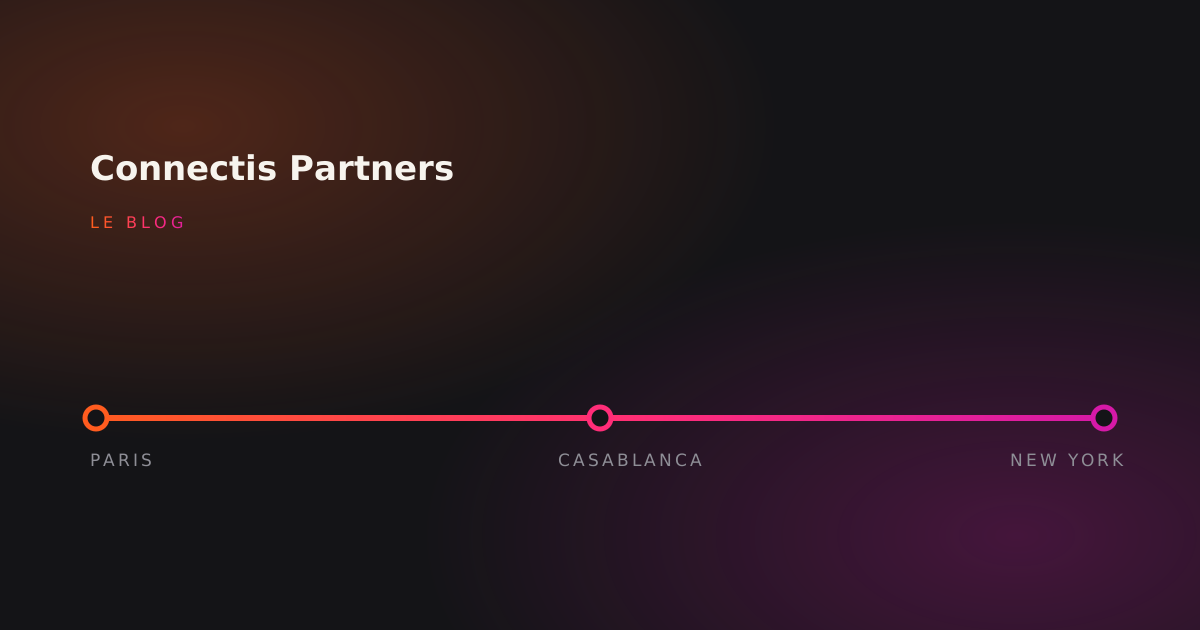
This is where Morocco comes in — and it's the logic of the Paris · Casablanca · New York corridor we operate.
The idea is simple: you keep a lean, senior commercial presence in the United States, and you back the entire engine — delivery, support, cross-functional teams — with a nearshore team in Morocco. Morocco's time zone overlaps the American morning and covers the full European day: your team works in real time with Europe and picks up the East Coast. You don't have to choose between the two continents, you chain them.
The economics speak for themselves. On support functions, we see up to 40% lower costs. On the payroll of a tech team set up in Tangier's offshore zone, up to 35% in the first year alone. Those euros saved on the engine, you reinvest where they truly matter: in the two or three senior salespeople who do need to be in the United States.
You enter the American market with the cost structure of a far larger company — and you last the distance your single-site competitors can't.
What we've seen work
Two lessons from our engagements sum up the method.
First, speed is an asset. We made an IT subsidiary operational for Ippon Technologies in under six months, with a fully local team aligned with headquarters' standards. For Financia Business School, a complete setup in Rabat in nine months. A well-built corridor doesn't cost you time in the target market; it gains you time, because the engine runs while you sell.
Second, the first stone is commercial, not structural. Before building anything, you have to confirm the market responds. Targeted B2B prospecting can generate more than 100 qualified leads and turn a hunch about entry into a real pipeline. That proof is what triggers the investment, not the other way around. You build the engine once demand is confirmed, not by betting it will come.
The right sequence
Winning in the United States isn't a leap. It's a sequence.
Validate the market through targeted prospecting before committing a single fixed cost. Place on the ground — and only on the ground — what has to be American: sales and customer relationships. Back everything else with a nearshore engine that gives you the cost structure to last. Then scale up in the US as revenue, not hope, justifies it.
At Connectis Partners, an American company, we operate this corridor between France, Morocco and the United States — it's our business, not a theory. If you're considering the American market and want to know what truly belongs there and what doesn't, tell us about your project: we'll give you a straight answer on where to start.